

Why Are Blue Light Glasses Red?
Because a lens that removes blue light cannot look clear. The colour is not styling. It is what removing blue light looks like.
The one minute explanation
Visible light runs from about 380 to 700 nanometres. Blue sits at the short end, roughly 400 to 500 nm. Green sits next to it. Red sits at the long end.
A tinted lens works by absorbing some wavelengths and letting others through. Whatever it lets through is the colour you see.
So if a lens absorbs the blue band, blue is not reaching your eye. Take out the blue and most of the green, and what is left arriving is the long end of the spectrum. That is red. The lens looks red because red is what is getting through.
Turn it around and the logic is the same: if a lens looks clear, every wavelength is getting through, including the blue. A clear lens can filter a small fraction and stay colourless. It cannot filter the band and stay colourless. Those are the same statement.
Then why are so many blue light glasses clear?
Because clear sells, and because most of them are built for a different job.
The mainstream blue light category in Australia is a daytime product. It is aimed at people at a desk who want something that filters a little of the violet and blue end without changing how anything looks, and without making them look unusual in an office. That is a real product with a real use, and a clear or faintly yellow lens is the correct design for it.
The problem is that both products are sold under the same three words. "Blue light glasses" now covers a lens that removes a small slice of the band and a lens that removes essentially all of it. Those are not variants of each other. They are different tools.
Why red and not amber
Amber is the halfway house, and for a lot of people it is the right one. It takes out most of the blue band while leaving colours usable enough to cook, read and hold a conversation in.
Red goes further. It takes out the blue band and continues into the lower green wavelengths sitting beside it. The trade is that colours change properly. Whether that trade is worth it depends on what you actually want the lens to do.
We wrote a longer comparison here: red, amber or yellow, which lens blocks what.
Does the red fade?
It depends how it was made, and this is worth checking on any pair you buy.
A tint applied as a coating sits on the surface of the lens. It scratches, and it can wear thin with cleaning. A tint bonded through the lens material is part of the lens itself. Same colour on day one and year three, because there is nothing sitting on top to come off.
Ours are bonded through. Most product pages will not tell you either way, which is usually an answer.
Getting used to it
The honest version: the first few minutes are strange. Colour information you rely on without thinking is gone. Then your visual system adapts and it stops being the thing you notice.
What does not go away is that a deep red lens is genuinely dark. That is why it is an indoor evening lens. Not for driving, not for stairs in a dim house, not for the middle of the day.
What we make
A deep red evening lens that blocks 99% of blue light across 400 to 500 nm. Matte acetate frame, non-prescription, bonded tint, $80, 30 days money back.
Keep reading
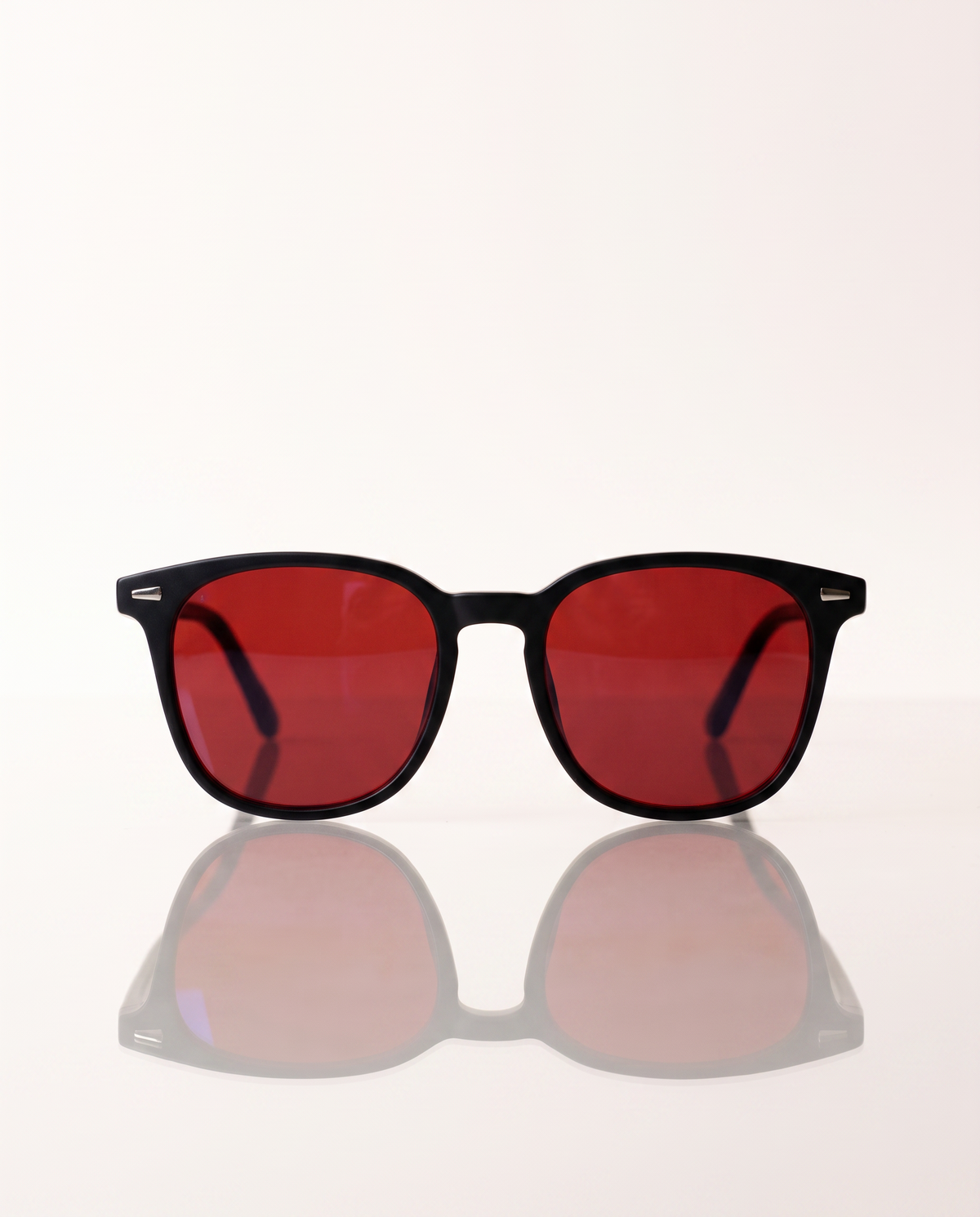
One lens. Deep red. $80.
99% of blue light blocked across 400 to 500 nm. The tint is bonded through the lens material rather than coated on the surface, so it does not wear off. Matte acetate, one size, non-prescription. Built for indoors after dark and honest about not being built for anything else.
Or get them free: subscribe to Whitening Toothpaste on the three-pack routine and a pair arrives in your welcome kit.
-
Free Shipping Australia Wide
-
Fast 3-5 Day Delivery
-
30-Day Money Back Guarantee