

How Much Blue Light Do Glasses Actually Block?
Anywhere from about 5% to essentially all of it, depending on the lens. The number on the box is close to meaningless on its own, and this page is about why.
A percentage without a range is not a specification
Here is the trick, and once you see it you cannot unsee it.
Blue light is a band, roughly 400 to 500 nanometres. A lens does not block it evenly. Most filters are strongest at the violet end, around 400 to 420 nm, and get progressively weaker as they move toward 480 and 500 nm, where blue starts turning into green.
So a brand can truthfully say "blocks 98% of blue light" while meaning 98% of the narrow slice its lens happens to be good at. Across the band a customer actually cares about, the real figure might be a fraction of that.
Watch for these:
- "Blocks blue light" with no number at all. Not a claim, an adjective.
- "Blocks up to X%". Up to is doing all the work in that sentence.
- A percentage with no nm range. The range is the entire specification. Without it the number is decoration.
- "Blocks harmful blue light". Harmful is not a wavelength.
What a real specification looks like: a percentage, a wavelength range, and a measurement to back it. For example, 99% across 400 to 500 nm.
Roughly what each lens type can do
These are ranges, not guarantees, and they follow from the physics of tinting rather than from any brand's technology.
| Lens | Realistic ceiling across the full blue band |
|---|---|
| Clear, blue-filtering coating | A small fraction. Strong at the violet end, weak past 450 nm |
| Light yellow | More, still partial across the band |
| Deep amber or orange | Most of the band |
| Deep red | Effectively the whole band, and into lower green |
The constraint is simple: a lens cannot remove a colour and still show you that colour. Tint depth sets the ceiling. No coating, membrane or proprietary anything gets around it. If two lenses claim the same blocking figure and one is clear and one is deep red, one of those claims is measured differently to the other.
The document that settles it
A spectral transmission chart. It plots wavelength across the bottom and percentage transmitted up the side, so you can read off exactly what gets through at every point rather than trusting a headline figure.
It comes from a spectrophotometer, it is cheap for a brand to obtain, and it is the only thing in this category that is genuinely not arguable. If a brand has one, they will usually show it. If they do not, that is information too.
Ask for it. Ours, and every competitor's.
Does more blocking mean better?
It means more suitable for after dark and less suitable for everything else. A deep red lens is the most complete filter and also the most restrictive thing to live in: colours shift, less light reaches you, and it is not safe for driving. A clear lens is easy to wear all day and filters comparatively little.
There is no lens that is both. Pick for the time of day you actually want it.
What we publish
99% of blue light blocked across 400 to 500 nm. Deep red, bonded through the lens material rather than coated on the surface. Non-prescription, matte acetate, $80.
Keep reading
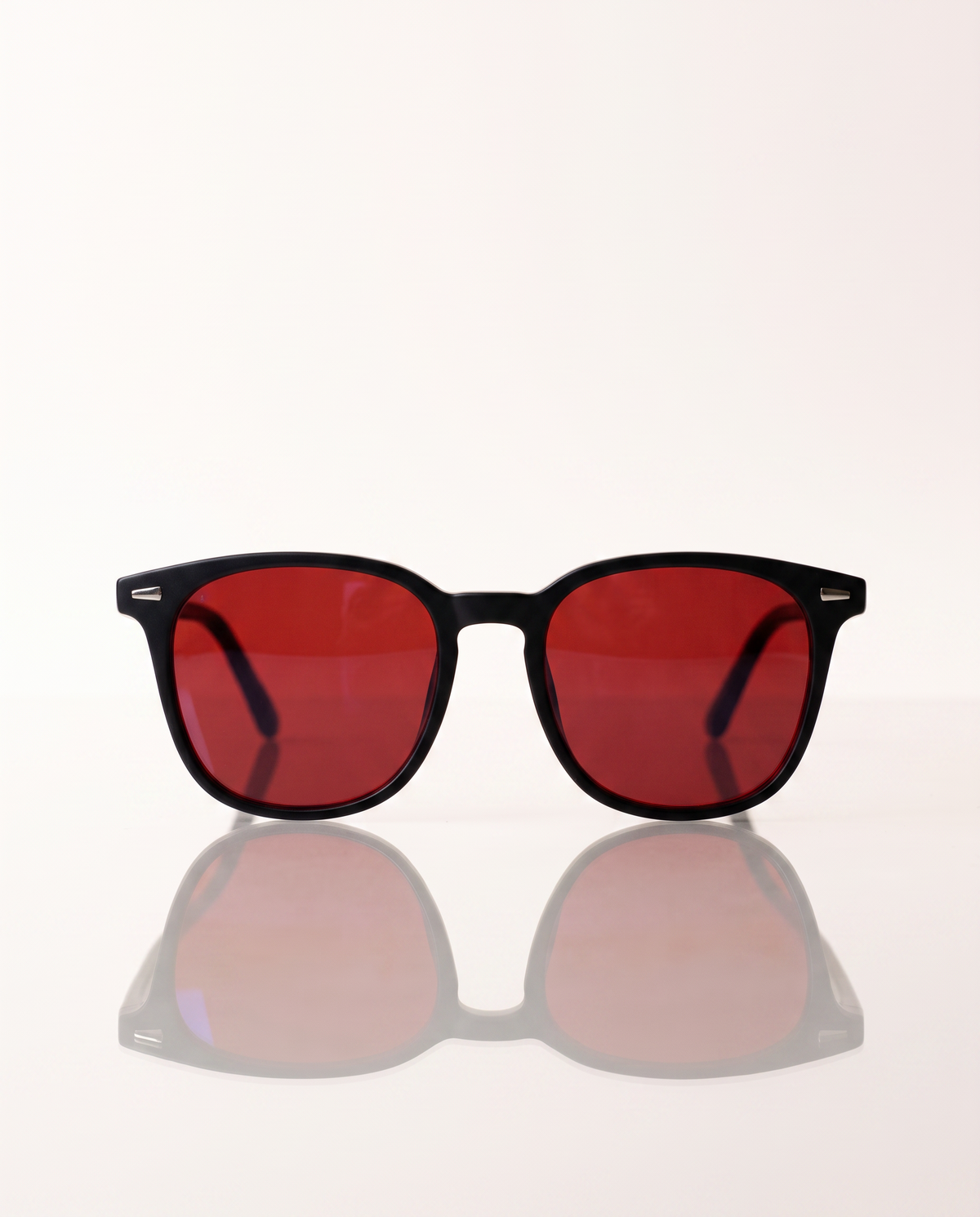
One lens. Deep red. $80.
99% of blue light blocked across 400 to 500 nm. The tint is bonded through the lens material rather than coated on the surface, so it does not wear off. Matte acetate, one size, non-prescription. Built for indoors after dark and honest about not being built for anything else.
Or get them free: subscribe to Whitening Toothpaste on the three-pack routine and a pair arrives in your welcome kit.
-
Free Shipping Australia Wide
-
Fast 3-5 Day Delivery
-
30-Day Money Back Guarantee