

Do Blue Light Glasses Work? What the Evidence Actually Says
We sell blue light glasses, so treat this page with the scepticism it deserves. We have tried to write the version we would want to read before spending $80.
Start with the headline that went around
In 2023 the Cochrane Collaboration published a systematic review of blue-light filtering spectacle lenses. It pooled 17 randomised controlled trials covering 619 adults, and it is the most rigorous look the category has had.
Its findings, plainly:
- Blue-light filtering lenses probably make little or no difference to eye strain from computer use in the short term.
- The evidence on sleep outcomes was inconclusive.
- There was not enough evidence to say anything about long term eye health.
One of the senior authors, Laura Downie, is at the University of Melbourne. This is Australian work, and the coverage of it shaped how a lot of people here now think about the category. Reasonably so.
Source: Cochrane Database of Systematic Reviews, 2023.
What that review was actually testing
This is the part that got lost, and it matters.
The lenses in those trials were, overwhelmingly, the everyday kind: clear or lightly tinted spectacle lenses with a blue-filtering treatment, worn generally, mostly assessed against computer use and eye strain. That is the product that fills the shelves at optical retailers, and it is the product the review found probably does not do much.
The review was not designed as a test of deep amber or deep red evening lenses. Those are a different intervention: a far heavier filter, worn only after dark, for a different reason. The review did not conclude they work. It also did not test them. Those are two different sentences and the coverage collapsed them into one.
So the honest state of play is not "debunked". It is: a specific and popular version of this product has been tested properly and came back unimpressive, and a different version of it has not been tested at anything like that standard. Less satisfying than either side wants. Also true.
What we are not going to tell you
We are not going to tell you these glasses will improve your sleep, help you fall asleep faster, or change anything measurable about your body. We do not have evidence that would support saying it, and in Australia a business making a health claim is required to be able to substantiate it. Most of this category says it anyway.
Language like clinically proven, science backed and proven to support your circadian rhythm is common across this category, and it usually appears with no citation attached to it. Read those claims the way you would read any other unsourced claim from someone selling you something. If a page says proven, the study should be on the page.
What we will tell you
A measurable statement about a lens is different from a promise about a person. What we can say is about the lens:
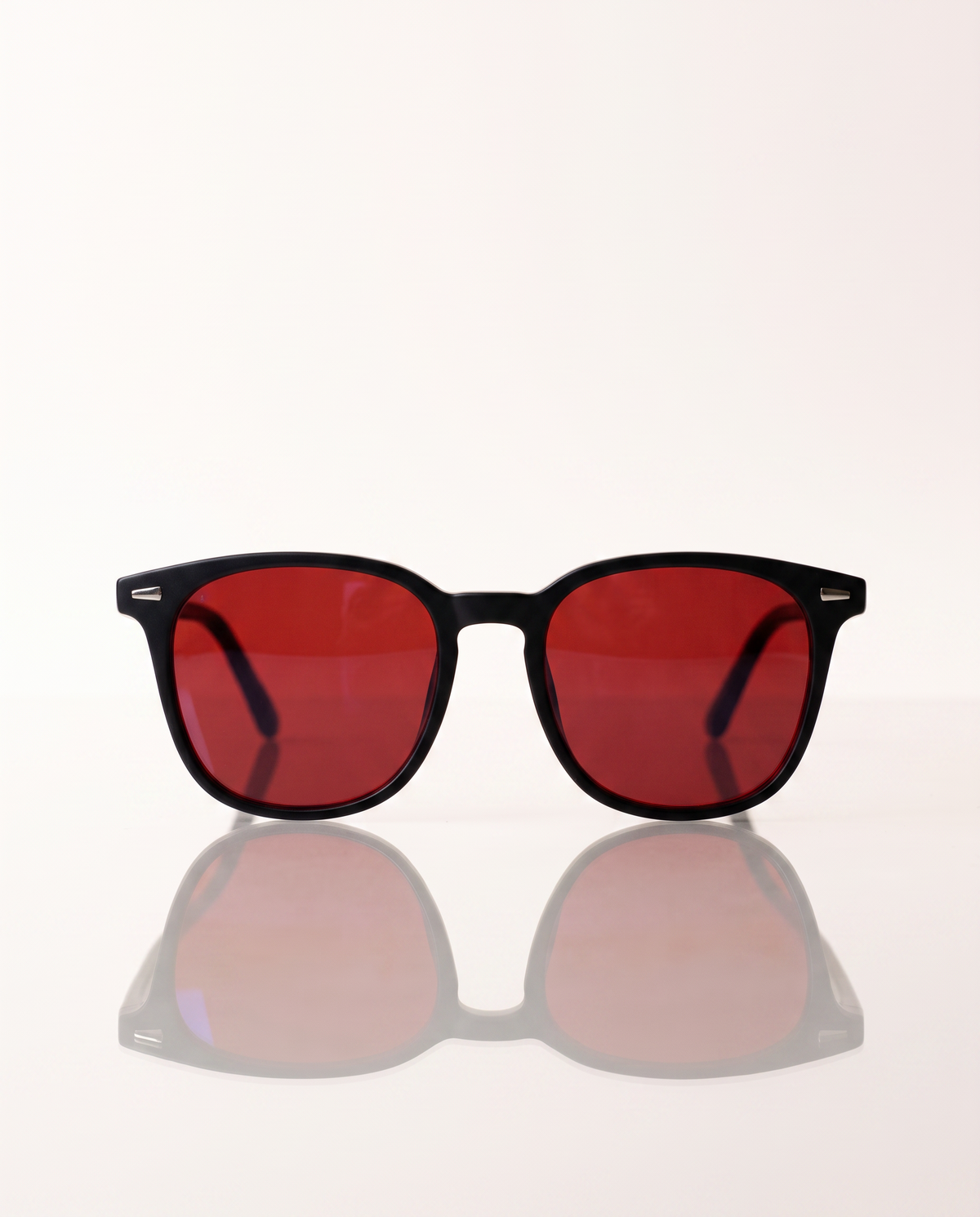
- It is a deep red tint, bonded through the lens material rather than coated on.
- It blocks 99% of blue light across 400 to 500 nm.
- It is built for indoor use after dark and it is not suitable for driving.
What that is worth to you is your call, not ours to promise.
How to judge any pair, ours included
- Ask which lens the claim applies to. Clear, yellow, amber and red are different filters with different capabilities. Evidence about one is not evidence about another, in either direction.
- Ask for the number and the range. "Blocks blue light" is not a specification. "Blocks 99% across 400 to 500 nm" is. A percentage without a wavelength range can hide almost anything.
- Ask for the measurement. A dated transmission chart from a lab beats any adjective. Very few brands in this country will produce one.
- Discount every outcome claim without a citation. If a page says proven, look for the study. If there is no study, you have learned what you needed to know about the page.
- Check the return policy. With a category this unsettled, being able to send them back is worth more than any claim on the page.
Where we land
The tint depth is the only part of this category that is not in dispute. A deep red lens removes far more of the blue band than a clear one, and that is measurable, verifiable, and not a matter of opinion.
Everything past that point is a question the research has not settled. We would rather sell you a well made lens and be straight about that than borrow confidence we have not earned.
See the Blue Light Blockers. $80, 30 days, money back.
Keep reading
One lens. Deep red. $80.
99% of blue light blocked across 400 to 500 nm. The tint is bonded through the lens material rather than coated on the surface, so it does not wear off. Matte acetate, one size, non-prescription. Built for indoors after dark and honest about not being built for anything else.
Or get them free: subscribe to Whitening Toothpaste on the three-pack routine and a pair arrives in your welcome kit.
-
Free Shipping Australia Wide
-
Fast 3-5 Day Delivery
-
30-Day Money Back Guarantee