

When Should You Wear Blue Light Glasses?
The answer depends entirely on which lens you bought, and almost nobody selling them makes that clear.
Two products, two schedules
Blue light glasses come in two genuinely different forms, and they are worn at opposite ends of the day.
| Clear or light yellow lens | Deep amber or red lens | |
|---|---|---|
| When | Daytime, at a desk | After dark, indoors |
| Filters | A fraction of the blue band | Most or all of the blue band |
| Colour shift | None to slight | Obvious |
| Safe to drive in | Yes | No |
Wearing the daytime lens at night is not doing much. Wearing the night lens in the daytime is the wrong tool and, outdoors, a genuinely bad idea. If a brand sells you one lens for both, ask which one it is actually good at.
If you have a deep red or amber lens
From sundown, indoors. That is the design brief. In practice that means the stretch of evening where every light source in your house is artificial: the overhead lights, the TV, the laptop, the phone, the bathroom mirror on the way to bed.
How long before bed is a matter of preference rather than a rule anyone can hand you. Some people put them on when the sun goes down. Most find the last hour or two is when it is worth the bother.
What matters more than the exact timing is that a lens covers everything. Night mode on a phone changes one screen. It does nothing about the ceiling light above you, the television across the room, or the fluorescent tube in the bathroom. That is the argument for a lens over a software setting, and it is the only argument that actually holds.
When not to wear them
- Driving. Not at any hour. A deep tint changes how much light reaches you and how you read colour, including brake lights and traffic signals.
- Outdoors in daylight. They are not sunglasses and they are not UV rated for it.
- Anywhere you need accurate colour. Cooking to colour, matching paint, editing photos. The lens is doing its job and its job is removing colour information.
- Moving around a dim house. Add light before you add lens. Stairs in the dark through a red tint is not a good combination.
If you have a clear or light yellow lens
Daytime, at a screen, and mostly for comfort. Worth knowing: the 2023 Cochrane systematic review found that this kind of lens probably makes little or no difference to computer related eye strain. We wrote about that in full on what the evidence actually says, including what the review did and did not test.
The practical version
Put them by the couch, not in a drawer. The single biggest reason people stop wearing evening glasses is that they live in the bedroom while the evening happens in the lounge room. Leave them where you actually sit.
What we make
A deep red evening lens. 99% of blue light blocked across 400 to 500 nm, bonded tint, matte acetate, non-prescription. Built for after dark and honest about not being built for anything else.
See the Blue Light Blockers. $80, 30 days, money back.
Keep reading
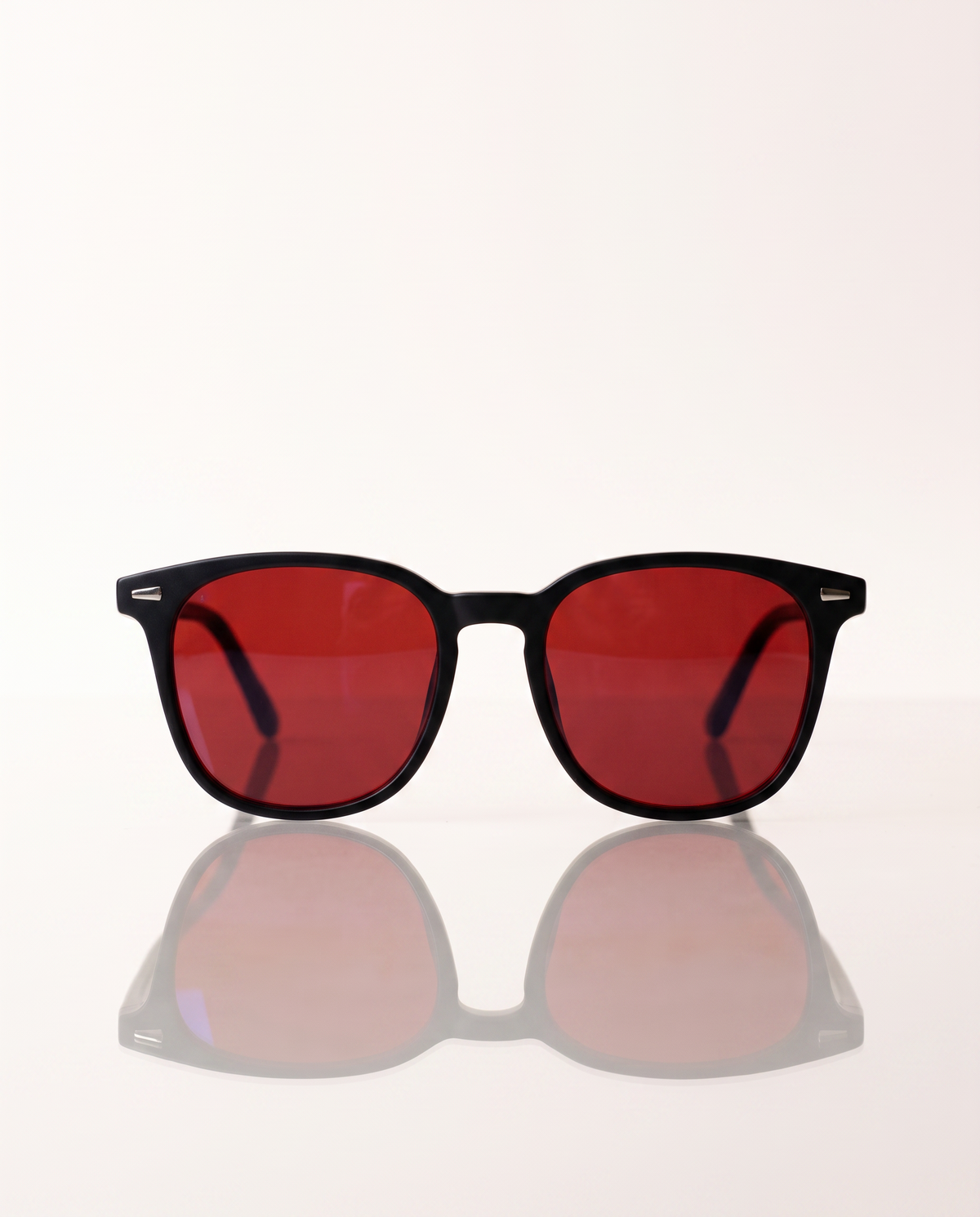
One lens. Deep red. $80.
99% of blue light blocked across 400 to 500 nm. The tint is bonded through the lens material rather than coated on the surface, so it does not wear off. Matte acetate, one size, non-prescription. Built for indoors after dark and honest about not being built for anything else.
Or get them free: subscribe to Whitening Toothpaste on the three-pack routine and a pair arrives in your welcome kit.
-
Free Shipping Australia Wide
-
Fast 3-5 Day Delivery
-
30-Day Money Back Guarantee