

Red, Amber or Yellow: Which Blue Light Lens Blocks What
Every blue light lens is a filter, and every filter has a colour. The colour tells you what the lens is removing. That is the whole story, and it is the part most product pages skip.
The short version
| Lens | How it looks | What it takes out | Built for |
|---|---|---|---|
| Clear | Looks like ordinary glasses | A small part of the blue range, mostly the violet end | Daytime desk work |
| Light yellow | Faint warm tint | More of the blue range, still partial | Daytime screens, gaming |
| Amber or orange | Obvious warm tint, colours shift | Most of the blue range | Evening |
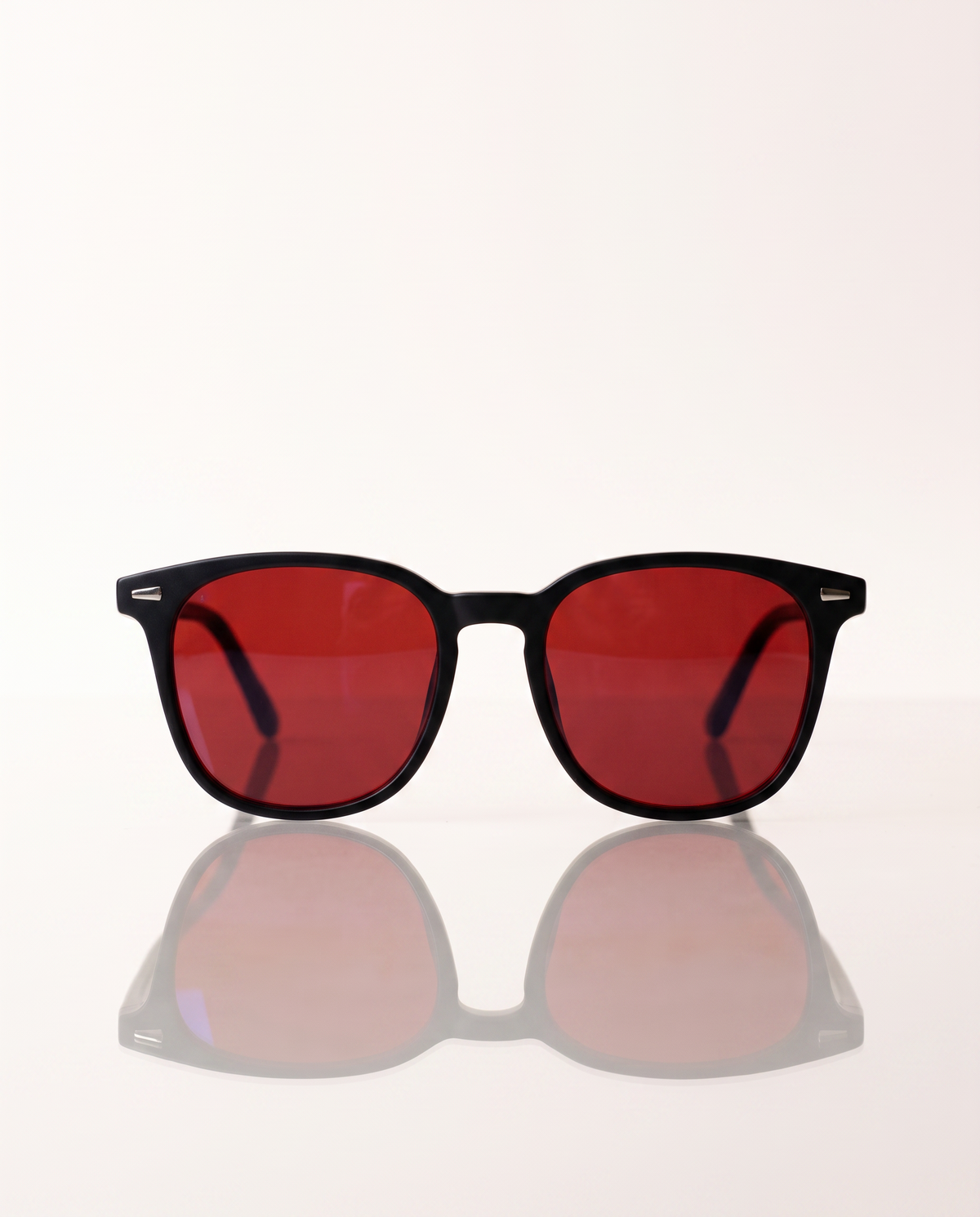
| Deep red | Strong red, colours change noticeably | Effectively the whole blue range, plus lower green | The hours after dark |
Why a clear lens cannot block blue light
This is the part worth sitting with, because once it lands, most of the marketing in this category stops working on you.
You see a colour when that wavelength reaches your eye. Blue light is the 400 to 500 nanometre band. If a lens removed all of it, blue would not reach your eye, and the lens could not look clear, because clear means every wavelength is getting through.
So a clear lens is not a lie, exactly. It is filtering something. It is just filtering a fraction, and the fraction is small enough that the lens stays colourless. That is fine for what it is. It is not the same product as an evening lens, and it should not be priced or described as though it were.
The rule that follows: the depth of the tint sets the ceiling on how much blue a lens can remove. No exceptions, no proprietary technology, no way around the physics.
Amber versus red
This is the real decision, because clear and yellow are daytime products and most people asking the question are asking about the evening.
Amber removes most of the blue band. Red removes the blue band and keeps going into the lower green wavelengths next to it. Practically, that means:
- Amber is easier to live in. Colours shift but stay usable. You can read, cook, hold a conversation without it feeling like a filter is on the room.
- Red is the more complete filter and the more demanding one. Colours change properly. Most people adjust within a few minutes and stop noticing.
If you want partial filtering and full colour usability, amber. If you want the lens to actually do the job it is named for, red.
The question to ask any brand
Ask for the transmission curve. Not a percentage in a headline, the actual measured chart showing what the lens transmits across the spectrum, from a lab, with a date on it.
Most brands in Australia will not have one. That tells you something. A percentage with no wavelength range attached is not a specification, it is a marketing number. "Blocks 90% of blue light" is meaningless unless you know across which nanometres, because a lens can block 90% of a narrow slice and almost none of the rest.
What we make
One lens, deep red, blocking 99% of blue light across 400 to 500 nm. The tint is bonded through the lens material rather than coated on the surface, so it does not wear off. Non-prescription, matte acetate, $80.
We do not make a clear lens or a yellow one, because we did not want to sell an evening product and a daytime product and pretend they were the same thing.
Keep reading
One lens. Deep red. $80.
99% of blue light blocked across 400 to 500 nm. The tint is bonded through the lens material rather than coated on the surface, so it does not wear off. Matte acetate, one size, non-prescription. Built for indoors after dark and honest about not being built for anything else.
Or get them free: subscribe to Whitening Toothpaste on the three-pack routine and a pair arrives in your welcome kit.
-
Free Shipping Australia Wide
-
Fast 3-5 Day Delivery
-
30-Day Money Back Guarantee